Posts

Showing posts with the label tracking devices for people

10 Factors to Consider When Selecting a GPS tracker

Image
This tutorial is about selecting a  personal tracking device  and getting started using it. Choosing a GPS receiver can be quite an overwhelming experience. If you look at handheld, portable GPS receivers that currently offer, you’ll have around 50–60 GPS receivers to choose from. That’s a lot of choices. And that’s only the beginning. After you purchase one, you still need to find out how to use it. This tutorial should take some of the confusion out of buying a GPS receiver and help you come up to speed using it. When it comes to selecting a GPS receiver, I won’t recommend that you buy a particular brand or model or tell you which is best for hiking, geocaching, or other activities. Rather, I follow more of a Socratic method, in which I ask you a number of questions that should help you make a pretty good and informed purchasing decision. Before you purchase a GPS receiver, you should spend some time kicking the proverbial tires. Don’t rush out and buy a receiver based ...

Real-Time Differential GPS may be approached in several ways

Image
While you can get more accurate fixes from such a system, it requires a number of additional, time-consuming steps, after data collection. Once you know the source of the differential corrections file, you have to get it, load it onto your computer, and execute software to produce the final corrected file. Wouldn’t it be nice if the  GPS tracker  simply gave accurate positions at the time you took the data? Further, there are some applications in which there simply isn’t time to postprocess GPS fixes–bringing a ship into a narrow harbor, for one example. Well, actually there is a way to provide instantaneous, accurate fixes: Real-Time Differential GPS. Getting Corrections for GPS Measurements – Right Now! Real-Time Differential GPS (RDGPS) may be approached in several ways: • The user can set up a base station over a known point and arrange for transmission of a radio signal from the base station to roving receivers. • The user’s  GPS Tracking Device ...

GPS tracking solutions - How to become a pro land navigator

Image
You may have a pretty good idea of what Global Positioning System (GPS) is and how it works. In addition to knowing about the satellites, ground stations, and receivers, however, you should have a grasp of some important concepts before you start using a GPS receiver — things like coordinate systems, datums, waypoints, routes, and tracks. Even if you already own a GPS receiver and have used it for a while, this is still a good chapter to skim through because some of these basic concepts that I discuss end up being overlooked in user manuals or can get a bit fuzzy if you don’t use your GPS receiver on a regular basis. Read on while I help clarify some important terms and concepts (like datums and waypoints and routes) so you’ll be (pardon the pun) moving in the right direction.   Linking GPS, Maps, and Coordinate Systems   Some people think that after they have a  tracking device  , they really don’t need a map, especially if the receiver has built-in mapping...

Portable tracker provides the most basic positioning services

Image
There are a variety of uses for GPS technology today, from basic positioning applications which might provide a traveller with their current location, speed, and direction to their destination, to highly complex applications where the user’s position information is feed into a system that provides location-specific features and services tailored for that user. What follows are some examples of how GPS technology is being used to enhance the capabilities of intelligent vehicle platforms. The initial examples illustrate some of the more traditional positioning applications, such as basic location and autonomous navigation systems, which are already seeing widespread use today. This is followed by examples describing how GPS-derived positioning information is being used to provide location-based services in vehicles today, and how the richness and complexity of those services will increase in the near future. A  portable tracker , while not strictly an intelligent vehicle system,...

System level solutions for GPS tracker

Image
When access to the GPS first became available for military and commercial use, only a few companies had the technology and expertise to develop reliable, accurate  GPS Tracking Device  . Application developers who needed GPS services would simply purchase a board level solution from a GPS supplier, and integrate it into their design. In the past, GPS correlators were designed with a single channel, which was multiplexed between each SV signal being received. This resulted in a very slow process for calculating a position solution. Today, systems come with up to 12 channels, allowing the correlator to process multiple SV signals in parallel, achieving a position solution in a fraction of the time. Also, while the correlator functionality is sometimes performed in software using a high-performance digital signal processor (DSP), the real-time processing requirements and repetitive high rate signals involved make a hardware correlator solution ideal, from both a cost and through...

GeoFencing on a GPS phone with Alert Escalation

Image
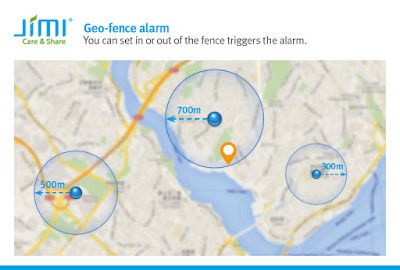
personal tracking device can utilize location information to potentially provide a safer tracked environment allowing vulnerable people to continue with their daily activities, as much as possible. This paper presents the options for alert escalation. The aim is to provide a safety net, without triggering unnecessary alarms. The escalation procedure involves initial speech alert to the user, then a speech and vibrate alert to the user as a reminder; this is followed by a text message to an identified carer if the user has not re-entered the designated safe zone. Parameters for alert escalation can be tuned to individual circumstances. The user can seek help by getting directions from the current position to home or by calling a carer. We report on a small user evaluation, an essential pre-requisite to testing with the intended cohort. The 21st century has brought an era of global population ageing. This will inevitably lead to an increase in the number of older people with dementia,...